The future battlefield is being rewritten in code, sensors, and autonomous systems and one of the most underestimated architects of this transformation is South Korea.
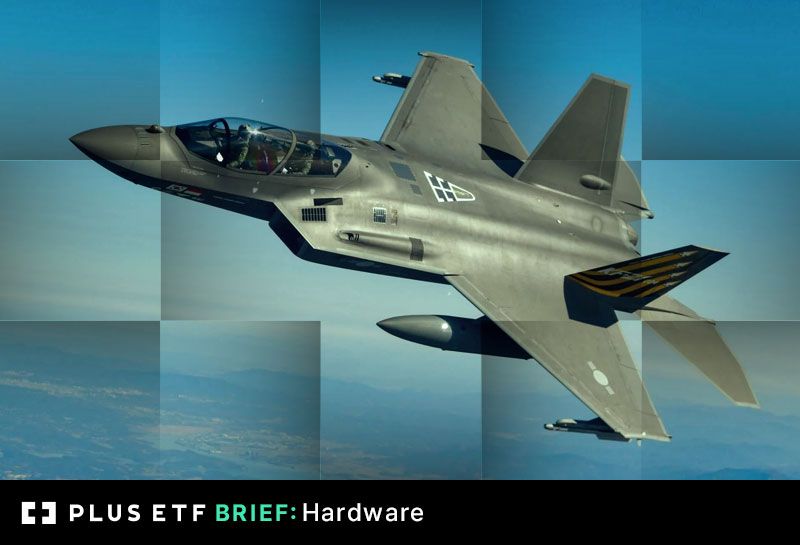 While investors often associate next-generation defense technology with the U.S. or Israel, Korea has quietly built a defense innovation machine that is now exporting advanced capabilities at speed, scale, and cost-efficiency few rivals can match. [1]
From Drone Swarms to AI-Enabled Targeting
Modern militaries are racing toward drone swarms, AI-enabled targeting, autonomous ground vehicles, and networked missile defense. These are not experimental concepts in Korea, they are production realities. [2] Companies held within the Plus Korea Defense Industry Index ETF (KDEF) sit at the intersection of cutting-edge military hardware and Korea’s world-class commercial technology base in semiconductors, robotics, and sensors.
The Companies Powering Korea’s Defense Leap
Several Korean defense leaders - held within the Plus Korea Defense Industry Index ETF (KDEF) -are driving this shift. Hanwha Aerospace has evolved far beyond traditional engines and artillery. Its portfolio now spans precision-guided munitions, space-launch systems, and advanced propulsion - technologies designed for high-tempo conflicts where speed, accuracy, and interoperability are decisive. The company’s innovations include loitering precision-guided weapons that use onboard AI to detect, identify, and strike targets during flight, a capability that is shaping future combat engagement models. [3] These systems are increasingly attractive to allies seeking rapid delivery without the political or logistical friction that often accompanies larger defense suppliers.
In missiles and electronic warfare, LIG Nex1 is pushing hard into AI-assisted missile guidance, radar, and command-and-control systems. As battlefields become saturated with data, the ability to detect, decide, and strike faster than an adversary is everything. LIG Nex1’s focus on smart seekers, networked missiles, and multi-domain defense reflects how wars are likely to be fought.
On the ground, autonomy and robotics are reshaping armored warfare. Hyundai Rotem, best known for the K2 Black Panther tank, integrates advanced sensors, automated fire control, and future-ready autonomous features. These platforms are designed for crews that need survivability and lethality in environments dominated by drones, precision strikes, and electronic warfare. This reflects how Korea’s land systems are evolving alongside global expectations for networked, semi-autonomous capabilities. [1]
In the air, Korea Aerospace Industries represents Korea’s ambition to move up the value chain. From advanced trainer aircraft to the KF-21 next-generation fighter program, KAI blends stealth shaping, modern avionics, and open-architecture systems that allow continuous upgrades, an increasingly critical advantage as software becomes as important as airframes. [1]
Why This Matters
What ties all this together is Korea’s dual-use innovation engine: modern semiconductors, artificial intelligence research, robotics, and sensor systems developed for commercial markets flow directly into advanced defense applications. This synergy has helped Korea’s defense exports grow in recent years, with its top firms collectively amassing over 100 trillion won in defense order backlog and expanding global footprint. [1]
For financial advisors and investors seeking exposure to the future of defense, KDEF aims to offer a focused gateway. It captures Korea’s defense-technology ecosystem and the broader supply chain powering autonomous systems, smart weapons, and aerospace innovation. As nations modernize their forces under tight timelines and budgets, Korea is no longer a supporting player. It is becoming a critical supplier of the next era of security and KDEF provides a way to invest directly in that reality.
Check KDEF’s Performance here. >>
[1] Han-kook, Jung & Seo-young, Kim, S. Korean defense giants set to surpass 100 trillion won in combines order, The Chosun Daily, 6/5/25.
[2] Eun-ji, Bahk, Korea’s Defense Industry Showcases AI, space tech at ADEX2025, The Korea Times, 10/21/25.
[3] Yoon-jung, Lee & Ji-hwan, Kim, Korea ramps up defense R&D to lead global advanced-weapons market, Chosun Biz, 1/8/26.
Hanwha Aerospace, LIG Nex1, Korea Aerospace Industries, Hyundai Rotem make 17.47%, 5.01%, 9.13%, 12.41%, respectively of KDEF as of 1/28/26.
Some of the companies highlighted herein are holdings of the PLUS Korean Defense Industry Index ETF portfolio. Please see plusetf.com/#fund-summary for complete holdings information. Holdings are subject to change.
Investors should consider the investment objectives, risks, charges and expenses carefully before investing. For a prospectus or summary prospectus with this and other information about the Fund, please call 1-855-900-0030 or visit our website at www.plusetf.com. Read the prospectus or summary prospectus carefully before investing.
Holdings are subject to change. For current holdings go to www.plusetf.com.
The Fund is distributed by Foreside Fund Services, LLC and Exchange Traded Concepts, LLC serves as the investment advisor of the funds. Foreside Fund Services, LLC is not affiliated with Exchange Traded Concepts, LLC or any of its affiliates.
Risk Disclosures:
Investing involves risk, including possible loss of principal. There is no guarantee the Fund will achieve their stated objectives. In addition to the normal risks associated with investing, international investments may involve the risk of capital loss from unfavorable fluctuation in currency values, differences in generally accepted accounting principles or social, economic or political instability in other nations. Emerging markets involve heightened risks related to the same factors as well as increased volatility and lower trading volume. The Fund’s concentration in an industry or sector can increase the impact of, and potential losses associated with, the risks from investing in those industries/sectors.
The Fund’s concentration in a single country or a limited number of countries will increase the impact of, and potential losses associated with, the risks from investing in those countries.
The Fund is non-diversified. The Fund is new and has a limited operating history for investors to evaluate. A new and smaller fund may not attract sufficient assets to achieve investment and trading efficiencies. In addition to the normal risks associated with investing, investments in smaller companies typically exhibit higher volatility.
The Fund may invest in securities denominated in foreign currencies. Because the Fund's NAV is determined in U.S. dollars, the Fund's NAV could decline if currencies of the underlying securities depreciate against the U.S. dollar or if there are delays or limits on repatriation of such currencies. Currency exchange rates can be very volatile and can change quickly and unpredictably.
The Fund is a recently organized investment company with no operating history. As a result, prospective investors have no track record or history on which to base their investment decision. Moreover, investors will not be able to evaluate the Fund against one or more comparable funds on the basis of relative performance until the Funds has established a track record.
One basis point (bps) is equivalent to 0.01%.


