On March 3, 2026, South Korea's broader stock market had one of its worst days in nearly two years.
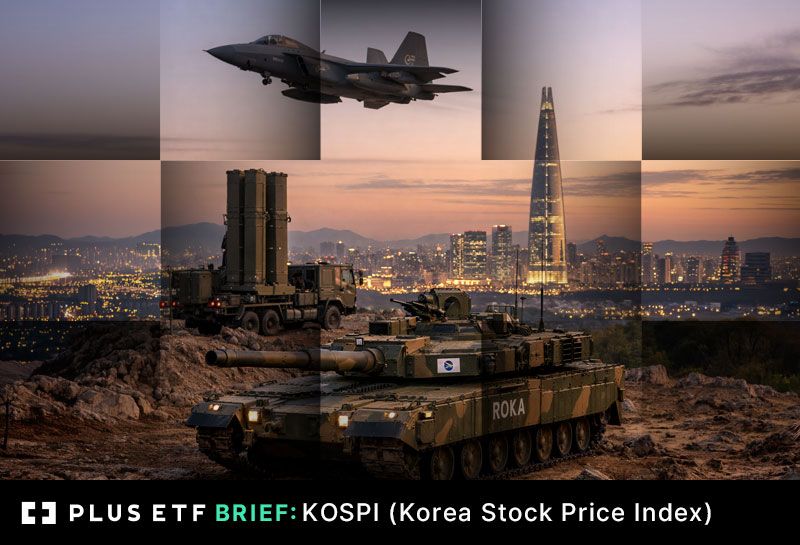 The KOSPI (Korea Stock Price Index) dropped 7.24%, rattling investors with broad exposure to Korea.¹ On that same trading day, a very different story was unfolding in the Korean defense sector. Hanwha Aerospace surged nearly 25%, LIG Nex1 soared 30% and anti-aircraft missile component maker Firstec gained 19%.¹ That divergence serves as one example of how targeted defense sector exposure may behave differently from a broad Korea allocation during periods of market stress and geopolitical tension.
That divergence is precisely what the Plus Korea Defense Industry Index ETF (KDEF) is designed to potentially capture.
A Sector Supported by Real Demand
The rally reflected broader fundamental trends: the global security environment has shifted significantly, and South Korea's defense industry has emerged as one of the world's more capable suppliers of NATO-standard weapons. The Iran war, the ongoing Russia-Ukraine conflict, and an accelerating European rearmament cycle have contributed to sustained weapons demand and South Korea has been increasingly positioning itself to meet it.
South Korea's four largest defense companies - Hanwha Aerospace, Hyundai Rotem, LIG Nex1, and Korea Aerospace Industries (KAI) - reported a combined 31% increase in arms revenues to $14.1 billion, according to the Stockholm International Peace Research Institute's 2024 Top 100 report.² Their combined order backlog has reached approximately 111.9 trillion won (roughly $81 billion), representing a significant pipeline of potential future revenue.³ Annual defense export contracts are approaching $23 billion, with South Korea now ranked as the second-largest arms supplier to NATO member states.⁴
The Companies Inside KDEF
Hanwha Aerospace, KDEF's largest holding at approximately 21% of the fund (as of 4/7/26), reported a record 1.43 trillion won in operating profit for the first half of 2025 - a fourfold increase year-over-year - driven by demand for K9 self-propelled howitzers and multiple-launch rocket systems.8 Its weapons sales climbed 42% to $8 billion, lifting it to 21st on SIPRI's global arms producer ranking.²
Hyundai Rotem, maker of the K2 Black Panther main battle tank and KDEF's second-largest holding at roughly 16% (as of 4/7/26), reported an order backlog of 29.77 trillion won as of year-end 2025, up 58.7% year-over-year, bolstered by a second K2 tank contract with Poland valued at approximately $6.5 billion. Iraq is currently in active negotiations for up to 250 K2 tanks in a potential deal estimated at $6.5 billion.9,10 Analysts have projected the company's defense operating profit may potentially grow approximately 26.6% in 2026.⁵
Korea Aerospace Industries (KAI), representing nearly 4.5% (as of 4/7/26) of the fund, is developing and beginning to deliver the KF-21 Boramae fighter jet to the Republic of Korea Air Force in 2026. KAI also exports its FA-50 light combat aircraft to countries including Poland and Malaysia, with an order backlog of approximately 23 trillion won.⁵
LIG Nex1, at roughly 5.4% of KDEF (as of 4/7/26), manufactures the Cheongung (M-SAM 2) air defense system, which has attracted significant procurement interest across the Gulf region following its combat debut during the Iran conflict. South Korean lawmaker Yu Yong-weon, a member of the National Defense Committee, reporting an approximately 96% interception rate against Iranian missile and drone attacks over the UAE - a performance that has materially accelerated export inquiries for Korean air defense systems across the region.11 In 2025, LIG Nex1's revenue grew 31.5% year-over-year to 4.31 trillion won, with operating profit surging 44.5% to 322.9 billion won.12
Why Broad Korea Exposure May Tell a Different Story
Most Korea-focused ETFs track the KOSPI broadly, providing exposure to semiconductors, consumer electronics, automotive, and financial stocks alongside defense. On March 3, 2026, that broad exposure fell more than 7%.¹ KDEF, a sector-specific fund with holdings concentrated in South Korean defense and defense-adjacent companies, reflected a materially different outcome on that day.¹
Past performance is not indicative of future results, and sector-specific funds carry their own risks, including concentration risk and geopolitical uncertainty. However, for investors seeking targeted exposure to the Korean defense sector, KDEF seeks to offer a specific approach from broad-market Korea funds.
KDEF launched in February 2025 and provides U.S. investors with access to Korean defense companies that may otherwise be difficult to access efficiently.⁷ South Korea has stated a national goal of becoming the world's fourth-largest defense exporter by 2030, and the government pledged an 8.2% increase in defense spending for 2026 which industry observers believe could potentially support continued sector growth.⁴
For investors evaluating how geopolitical risk may influence portfolio construction, KDEF provides exposure to a sector that has, at times, exhibited different performance characteristics during periods of broader market stress and geopolitical tension.
Holdings subject to change. Click here to view all holdings.
Sources:
[1] CNBC. "South Korea Defense Stocks Soar with Heavyweight Hanwha Aerospace Surging 20% as Traders React to Iran War." March 3, 2026.
[2] Korea Herald. "K-Defense Climbs Global Rankings on Europe Export Boom." December 2, 2025.
[3] Defence Blog. "South Korean Defense Firms Report Record Profits." August 18, 2025.
[4] Asia Pacific Defence Reporter. "South Korea's Defence Technology Export Boom Explained." February 5, 2026.
[5] Seoulz. "South Korea's Defense Industry Big 4 in 2025." December 3, 2025.
[6] Stock Analysis. "LIG Nex1 Co., Ltd. (KRX: 079550) Stock Price and Overview." Accessed April 8, 2026.
[7] Stock Analysis. "KDEF Holdings — PLUS Korea Defense Industry Index ETF." Accessed April 8, 2026.
[8] Korea Herald. "Hanwha Aerospace Posts Record Q2 Earnings on Defense, Shipbuilding Boom." July 31, 2025.
[9] Aju Press. "Hyundai Rotem Posts Record Profit on K2 Tank Exports to Poland." January 30, 2026.
[10] UPI (United Press International). "Hyundai Rotem Eyes Broader K2 Tank Exports in 2026, Kiwoom Says." January 22, 2026.
[11] TheStreet Pro. "As Iran Conflict Weighs on Markets, the Korean Defense Sector Is Thriving." April 7, 2026.
[12] Asia Economic Daily. "LIG Nex1 Posts 322.9 Billion Won Operating Profit in 2025...Up 44.5% from Previous Year." February 13, 2026.
Investors should consider the investment objectives, risks, charges and expenses carefully before investing. For a prospectus or summary prospectus with this and other information about the Fund, please call 1-855-900-0030 or visit our website at www.plusetf.com. Read the prospectus or summary prospectus carefully before investing.
Holdings are subject to change. For current holdings go to www.plusetf.com.
The Fund is distributed by Foreside Fund Services, LLC and Exchange Traded Concepts, LLC serves as the investment advisor of the funds. Foreside Fund Services, LLC is not affiliated with Exchange Traded Concepts, LLC or any of its affiliates.
Risk Disclosures:
Investing involves risk, including possible loss of principal. There is no guarantee the Fund will achieve their stated objectives. In addition to the normal risks associated with investing, international investments may involve the risk of capital loss from unfavorable fluctuation in currency values, differences in generally accepted accounting principles or social, economic or political instability in other nations. Emerging markets involve heightened risks related to the same factors as well as increased volatility and lower trading volume. The Fund’s concentration in an industry or sector can increase the impact of, and potential losses associated with, the risks from investing in those industries/sectors.
The Fund’s concentration in a single country or a limited number of countries will increase the impact of, and potential losses associated with, the risks from investing in those countries.
The Fund is non-diversified. The Fund is new and has a limited operating history for investors to evaluate. A new and smaller fund may not attract sufficient assets to achieve investment and trading efficiencies. In addition to the normal risks associated with investing, investments in smaller companies typically exhibit higher volatility.
The Fund may invest in securities denominated in foreign currencies. Because the Fund's NAV is determined in U.S. dollars, the Fund's NAV could decline if currencies of the underlying securities depreciate against the U.S. dollar or if there are delays or limits on repatriation of such currencies. Currency exchange rates can be very volatile and can change quickly and unpredictably.
The Fund is a recently organized investment company with no operating history. As a result, prospective investors have no track record or history on which to base their investment decision. Moreover, investors will not be able to evaluate the Fund against one or more comparable funds on the basis of relative performance until the Funds has established a track record.
One basis point (bps) is equivalent to 0.01%.


